 BEA Summit is Live
BEA Summit is Live
BEA Summit is Live
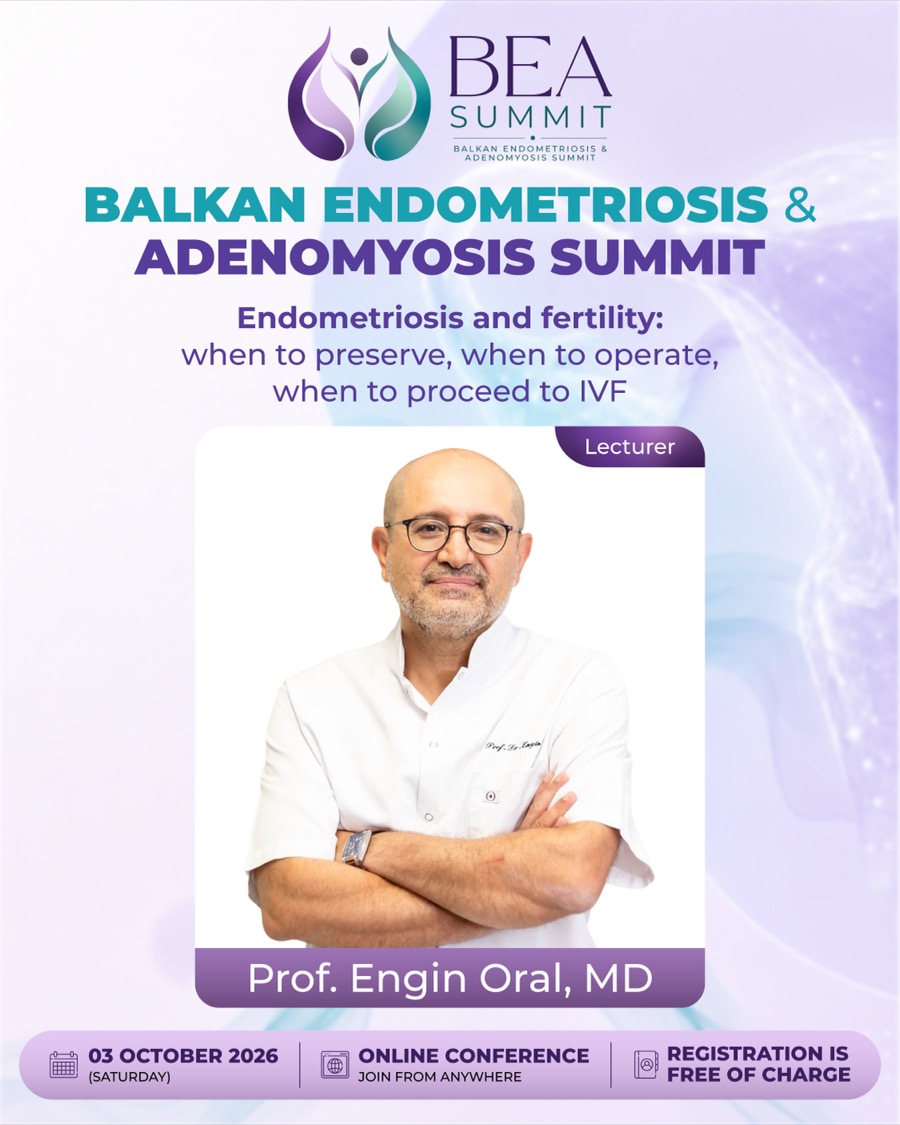
Prof. Engin Oral is a leading Turkish reproductive endocrinologist and gynaecological surgeon whose career has been dedicated to endometriosis, infertility, IVF and reproductive surgery. He graduated in medicine with first-class honours, specialised in obstetrics and gynaecology at Cerrahpaşa, and subsequently undertook postdoctoral training in reproductive endocrinology and infertility at Yale University. Prof. Oral is a professor at Istanbul University Cerrahpaşa, works at the Acıbadem Healthcare Group and, since 2025, has been an affiliated professor at Umeå University. His research explores the complex balance between surgery, ovarian reserve, fertility and IVF. He is the founder of the Turkish Society for Endometriosis and Adenomyosis, a former president of the European Endometriosis League and co-chair of the World Congress on Endometriosis 2027.
On 3 October 2026, Prof. Engin Oral will join the Balkan Endometriosis & Adenomyosis Summit 2026 - a free, online conference in English bringing together leading specialists and patient organisations from across the region.
The interview with Prof. Engin Oral traces how his early academic success and formative training at Yale shaped his career in reproductive endocrinology and endometriosis care. He explains why decision-making for patients with endometriosis, infertility, and IVF is so complex and why a personalized approach based on age, ovarian reserve, and symptoms is key. The interview also outlines the future of treatment—better medication options, wider use of fertility preservation, and more structured international scientific collaboration.
Graduating from medical school with a high ranking requires regular and hard work. Istanbul
University is one of the oldest and most established medical schools in Türkiye. My education
there gave me a strong working discipline and the habit of reading and studying regularly.
After graduation, I decided to specialise in obstetrics and gynaecology. At that time, I had not
yet decided to focus on reproductive endocrinology. However, my interest in obstetrics and
gynaecology during medical school later shaped my career in this direction.
My training at Yale was an important turning point in my career. During that period, I focused
mainly on reproductive endocrinology and endometriosis. Working with two internationally
well-known mentors improved both my clinical and scientific knowledge.
When I returned to Türkiye, I decided to continue my work in reproductive endocrinology.
I also wanted to study endometriosis in both clinical practice and scientific research.
The department at Yale was very strong in this field. I also had the opportunity to attend scientific
meetings in the United States and visit different centres. These experiences broadened my
knowledge and perspective. I was also impressed by the research being conducted at the NIH
at that time. In the early 2000s, seeing that endometriosis was already receiving such
scientific attention was very important and encouraging for me.
Endometriosis, infertility, IVF, and reproductive surgery are closely related. A significant
proportion of patients with endometriosis also have infertility. Some of these patients may
also need reproductive surgery.
For this reason, it is not enough to assess the patient only from the perspective of IVF,
endometriosis, or surgery. Training and experience in all these areas allow you to evaluate the
patient as a whole. This helps you choose the most suitable treatment and manage the patient
together with an experienced IVF team when necessary.
The main factors are the patient’s age, current ovarian reserve, main complaint, previous
surgeries, and medical history. It is also important to determine whether pain or infertility is
the main problem. Decision-making is particularly difficult in older patients, patients with
diminished ovarian reserve, and those with advanced endometriosis.
Therefore, the approach should be individualised for each patient. We need to decide whether
to preserve fertility first by freezing oocytes, perform surgery, or proceed directly to IVF. The
patient’s age, ovarian reserve, symptoms, and history of endometriosis surgery should all be
considered together before making this decision.
I can say with pride that we founded the Endometriosis and Adenomyosis Society in 2009,
when endometriosis was still not widely known in Türkiye. I led this process together with
my colleagues and served as the founding president for many years. I am currently serving as
president again.
In 2016, I was elected to the board of the European Endometriosis League, and I later had the
opportunity to serve as its president for two years. These positions helped us increase
awareness of endometriosis in Türkiye and neighbouring countries. Through the meetings,
educational activities, and patient-related work of our Society, endometriosis has become
better recognised in the region.
The European Endometriosis League and the Endometriosis and Adenomyosis Society of
Türkiye still work in close collaboration. Several of our colleagues have also taken part in the
League’s young groups and board.
About two years ago, I was appointed as an affiliated professor at Umeå University in Sweden
based on our scientific work. This position gave me a different academic perspective.
Northern European countries are very strong in scientific research in this field.
My collaboration with Umeå University has also expanded my international academic
network. We are still working on joint projects. I believe these collaborations contribute to my
academic work, our Society, and the scientific position of our country.
About three-quarters of my publications are related to endometriosis, and some of them also
focus on reproduction and infertility. One of the main points from our work is that patients
with endometriosis need a more careful and individualised approach during IVF treatment.
Many of these patients have diminished ovarian reserve, and other conditions may also be
present. Therefore, they should be evaluated carefully. If the patient is assessed correctly and
managed by an experienced IVF team, satisfactory results can be achieved.
In the next ten years, I expect important developments in the medical treatment of
endometriosis and in methods for preserving ovarian reserve. I believe these developments
will be particularly important for patients with endometriosis.
Awareness of fertility preservation, especially oocyte freezing, will also increase among both
doctors and patients. As a result, these procedures will probably be used more often and at a
more appropriate time. My main expectation for the next decade is to have better treatment
options for endometriosis and more effective ways to preserve ovarian reserve.
Register free to attend Prof. Engin Oral, MD’s session and the full BEA Summit 2026 programme.
Register Now