 BEA Summit is Live
BEA Summit is Live
BEA Summit is Live
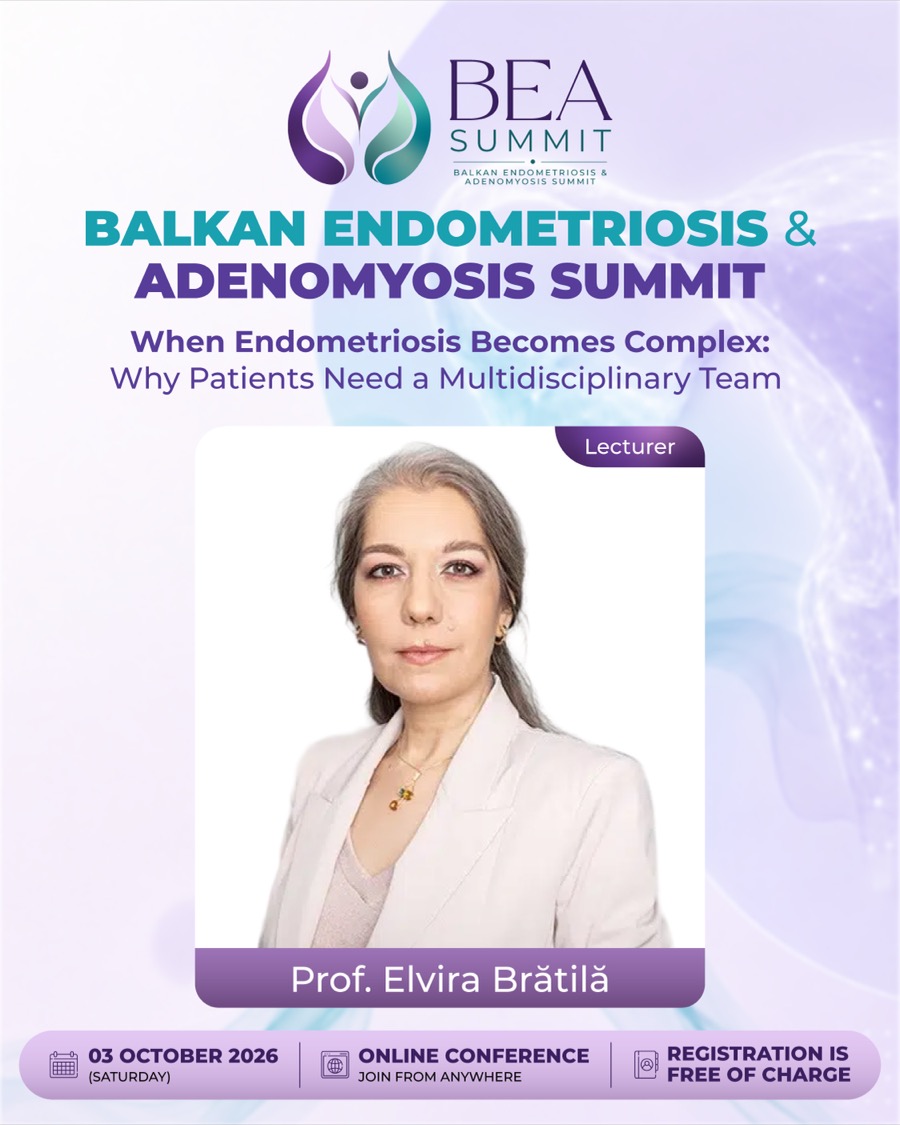
Prof. Dr Elvira Bratila is a leading Romanian obstetrician-gynaecologist and gynaecological surgeon, specialising in the surgical treatment of endometriosis, with many years of academic and clinical experience at Carol Davila University and the ‘Panayot Serbu’ Clinical Hospital. She heads the multidisciplinary EndoMedicare Academy centre, which brings together specialists from various fields to provide comprehensive diagnosis and treatment of complex cases of endometriosis. Prof. Bratila is one of the pioneers of robotic gynaecological surgery in Romania and has introduced modern, minimally invasive approaches to gynaecological conditions, including urogynaecological and reproductive issues. She is President of the Romanian Society of Obstetrics and Gynaecology and of the Eastern European Society for Endometriosis and Infertility, and works actively to promote the multidisciplinary model of care.
On 3 October 2026, Prof. Bratila will take part in the “Balkan Endometriosis & Adenomyosis Summit 2026” – a free online conference in English that brings together leading specialists and patient organisations from across the region. You can find the full programme for the event and the free registration form HERE.
The interview with Prof. Elvira Bratila explores how her dual role in academic and clinical practice has shaped her vision for modern, coordinated care for women in Romania. She explains the challenges involved in treating advanced endometriosis, where surgery requires precision, a deep understanding of anatomy and a balance between radical treatment and preserving function. Prof. Bratila discusses the rise of robotic surgery and the EndoMedicare Academy model, which brings together different specialists around a single patient pathway to avoid fragmented care. The interview also outlines the future of endometriosis medicine – more specialised centres, more accurate diagnosis, technological advances and a shift towards personalised, multidisciplinary approaches.
Holding leadership positions both within academia and within a major clinical hospital gives me the opportunity to see women’s health from two complementary perspectives: education and patient care. I believe that these two areas cannot be separated.
At Carol Davila University, my responsibility is to help train the next generation of obstetricians and gynaecologists, to promote scientific thinking and to encourage young physicians to continuously develop their skills. At Prof. Dr. Panait Sârbu Clinical Hospital, I see every day the complexity of the patients we treat and the gaps that still exist in access to high-quality care.
This has shaped my vision around three fundamental principles: excellence in medical education, access to evidence-based care, and multidisciplinary collaboration.
For me, improving women’s health in Romania means not only having highly skilled individual physicians, but also building systems in which expertise is connected, patients are diagnosed earlier and appropriately, and complex cases are referred to teams with the necessary experience.
Advanced endometriosis is challenging because the disease is not confined to one organ. Deep infiltrating lesions may involve the bowel, bladder, ureters, parametria, pelvic nerves, diaphragm or other retroperitoneal structures, while simultaneously affecting fertility and the patient's quality of life.
The greatest challenge is therefore not simply removing lesions. It is achieving complete or radical excision of disease while preserving the functional integrity of the organs involved.
These operations require a detailed understanding of pelvic anatomy, careful preoperative mapping and the ability to adapt the surgical strategy according to the individual patient. In many cases, the surgeon must make decisions that balance radicality with preservation of fertility, urinary, bowel and sexual function.
This is why advanced endometriosis surgery should be approached as complex pelvic surgery, rather than as a routine gynaecological procedure.
Robotic surgery has expanded what we can achieve in complex minimally invasive surgery. Its greatest value, in my experience, is not that it replaces surgical expertise, but that it provides an additional level of precision and control.
Three-dimensional vision, articulated instruments, improved ergonomics and fine tissue dissection are particularly valuable when operating in anatomically difficult areas such as the parametria, ureteral region, retroperitoneum or around delicate vascular and neural structures.
However, I always emphasise that technology is important, but the surgical concept is fundamental. A robot cannot compensate for insufficient anatomical knowledge or an inadequate surgical strategy.
The real benefit appears when advanced technology is combined with appropriate patient selection, detailed imaging, surgical experience and a multidisciplinary team. That combination allows us to approach increasingly complex cases while maintaining the principles of organ and functional preservation.
The model developed from a very simple observation: patients with complex endometriosis were often moving between different specialists, receiving fragmented opinions and sometimes undergoing repeated procedures without a unified strategy.
I wanted to create a different pathway — one in which the patient is at the centre and the specialists communicate with one another.
At EndoMedicare Academy, imaging is not separate from surgery, fertility is not separate from disease management, and postoperative care is not an afterthought. We try to create a continuous pathway from diagnosis and disease mapping to treatment, fertility planning, surgery and follow-up.
Our multidisciplinary team has worked together for many years, and this continuity is extremely important. Complex endometriosis requires not only individual expertise, but collective expertise applied to the same patient and the same therapeutic objective.
The main risk is fragmentation of care. When a complex disease is approached one organ or one symptom at a time, the overall picture may be missed.
This can lead to incomplete diagnosis, inadequate preoperative planning, incomplete treatment of disease or repeated interventions. In some patients, surgery may also compromise ovarian reserve, fertility or organ function if the broader therapeutic objectives were not considered from the beginning.
Another important issue is that endometriosis is not only a surgical disease. A patient may need fertility counselling, specialist imaging, pain management, psychological support, pelvic-floor expertise or other surgical disciplines depending on the extent of disease.
Multidisciplinary care allows these aspects to be integrated into one strategy. The objective is not simply to perform an operation, but to achieve the best possible long-term outcome for the woman as a whole.
The research that has influenced me most is the body of evidence showing how heterogeneous endometriosis is and how strongly its impact depends on disease location, extent, symptoms, fertility goals and functional consequences.
This has reinforced my belief that there is no universal treatment algorithm that can simply be applied to every patient.
In particular, advances in imaging have changed the way we approach deep endometriosis. High-quality ultrasound and MRI can provide detailed preoperative mapping and allow us to anticipate complex anatomical involvement before entering the operating room. This is extremely important for surgical planning and patient counselling.
Research in reproductive medicine has also strengthened the importance of considering fertility from the beginning, particularly when ovarian endometriosis is present.
Finally, our increasing understanding of the relationship between radical excision, recurrence, pain and organ function has reinforced one principle in my practice: the goal is not simply to remove visible disease, but to achieve complete disease control while preserving function whenever possible.
I see considerable progress, but also significant differences between countries and healthcare systems.
There is a growing recognition that endometriosis requires specialised expertise and that complex cases should be managed in centres with appropriate multidisciplinary teams and surgical experience. Education is also becoming increasingly important — particularly training in advanced ultrasound, minimally invasive surgery and complex endometriosis surgery.
For Eastern Europe, I believe collaboration is particularly valuable. We need to create stronger networks between centres, facilitate training and exchange of expertise, and establish common standards for diagnosis, treatment and quality assessment.
As professional societies, we also have a responsibility to move beyond awareness and towards structured, measurable improvements in patient care.
My vision is that a woman should not receive a fundamentally different level of care simply because she lives in one country or another within our region. We need to reduce these disparities through education, collaboration, referral networks and centres that are evaluated according to objective standards.
Your Summit talk focuses on why complex endometriosis requires a multidisciplinary team. What developments do you expect in the next decade in how we organise care for these patients?
I expect the next decade to bring a major transition from fragmented care towards integrated endometriosis care pathways.
First, I believe specialised endometriosis centres will become increasingly important, particularly for patients with deep and multi-organ disease. These centres should not simply carry the name “centre of excellence”; their expertise should be demonstrated through objective criteria, appropriate infrastructure, multidisciplinary teams, outcomes and continuous quality assessment.
Second, diagnosis will become increasingly precise. Advanced ultrasound and MRI, combined with structured disease classification and better imaging expertise, will allow us to map disease more accurately before surgery.
Third, technology will continue to evolve. Robotic and advanced laparoscopic surgery, artificial intelligence and digital tools may improve surgical planning, education and patient follow-up. But technology should remain a tool — not the centre of the model.
Finally, I hope we will increasingly organise care around the patient journey rather than around individual medical specialties.
The future of endometriosis care is not simply about performing more sophisticated operations. It is about knowing which patient needs surgery, which patient needs fertility preservation, which patient needs medical treatment, and when several of these approaches need to be combined.
Ultimately, I believe the most important development will be a change in mindset: from treating individual lesions or symptoms to providing personalised, coordinated and function-preserving care for the woman with endometriosis.
Register free to attend Prof. Elvira Brătilă’s session and the full BEA Summit 2026 programme.
Register Now