 BEA Summit is Live
BEA Summit is Live
BEA Summit is Live
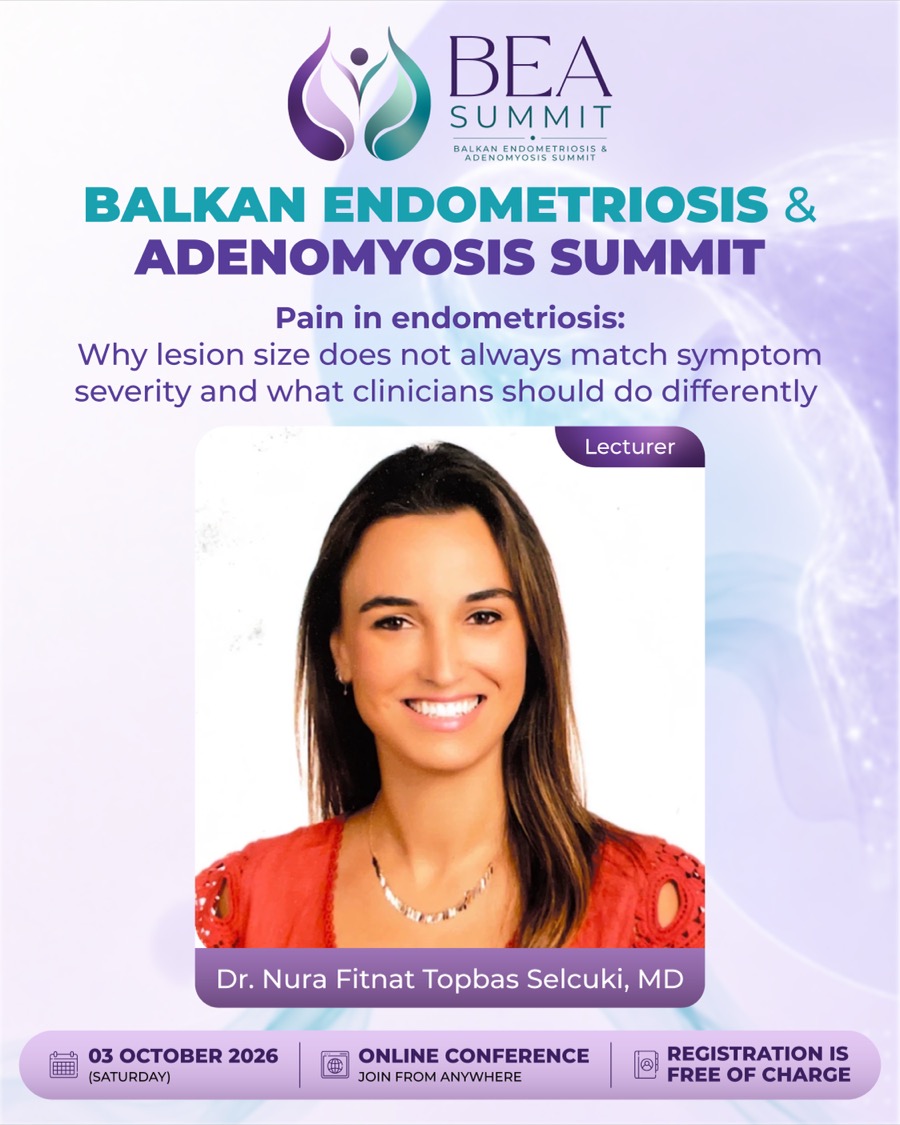
Dr. Nura Fitnat Topbas Selcuki is an obstetrician-gynecologist and researcher who combines clinical endometriosis care in Istanbul with academic work at the University of Oxford. She has a strong international educational background—Cornell, Heidelberg, and a residency in obstetrics and gynecology in Turkey—which shapes her research focus on the genetic basis of endometriosis and adenomyosis and on the inclusion of more diverse research populations. Her publications cover genetics, oxidative stress, thoracic endometriosis, and chronic pelvic pain, including a landmark 2026 study on the discrepancy between pain and the apparent severity of the disease. She is a long-standing ambassador for the World Endometriosis Society and an active member of the Turkish Society for Endometriosis and Adenomyosis, playing a leading role in international scientific communication.
On 3 October 2026, Dr Topbas Selcuki will join the Balkan Endometriosis & Adenomyosis Summit 2026 - a free, online conference in English bringing together leading specialists and patient organisations from across the region.
The conversation with Dr. Nura Fitnat Topbas Selçuk shows how her international career path—spanning Cornell, Heidelberg, Turkey, and Oxford—has shaped a multidisciplinary approach to endometriosis that combines genetics, clinical practice, and global data. She explains why pain in endometriosis cannot be measured by the size of the lesions and why clinicians should treat pain as a distinct mechanism rather than a secondary symptom. The interview outlines the future of science—greater ancestral diversity, better mapping of neuroinflammation, and personalized strategies for diagnosing and treating pain.
Each setting gave me a different lens, and endometriosis needs all of them. Cornell, where I did my bachelor's in genetics, gave me the foundation for thinking about disease at the molecular level, a thread that runs right through to my later work. Heidelberg, where I trained in medicine, grounded me in clinical rigour and a whole-body way of thinking about disease. Türkiye is where I see the day-to-day reality of patient care at scale, and the diagnostic delays and access gaps that no single-centre study captures. Oxford, at the Endometriosis CaRe Centre, brought the two together, genetics and large-scale phenotyping to ask why the disease behaves so differently between women.
What ties them together is a conviction that endometriosis can't be understood from one discipline or one health system. Moving between them taught me to distrust tidy single-cause explanations, to value international data-sharing, and to keep the patient's lived experience central whether I'm at the bench, the operating table, or in clinic.
The advantage is that each side keeps the other honest. In clinic I see the questions that matter, why one woman's disease is silent and another's disabling, why symptoms and lesion burden so rarely align. Those questions drive the research, and the genetics lets me answer them in ways daily practice can't. A patient in Istanbul isn't an abstraction when I'm analysing data in Oxford; she's the reason it matters.
The challenges are the two clocks: clinical work is immediate and relentless, research slow and iterative, and holding both means constantly switching gears across countries, systems, and data standards.
Several stand out. First, translating genetic associations into mechanism: GWAS has given us several robust risk loci, but we still understand too little about how they act in tissue to cause disease. Second, the genetic relationship between endometriosis and adenomyosis: they co-occur frequently in clinic, yet how far they share a genetic architecture is still open and answering it would reshape how we classify both. Third, linking genetics to phenotype at all: we can't yet explain why the disease ranges from silent to disabling, or map subtypes to their biology, because the genotype–phenotype connections simply aren't established. My thesis worked on the genetic and phenotypic side of this, and if anything, it convinced me that large-scale, deeply phenotyped, well-shared datasets are the precondition for progress.
Most endometriosis genetics to date has been done in populations of European ancestry, which limits what we can conclude. Two things change when we broaden that. First, accuracy: risk variants and their frequencies differ across ancestries, and polygenic risk scores built on European data lose predictive power when applied elsewhere. Including Turkish and Eastern Mediterranean cohorts and others helps distinguish signals that are truly causal from those that are population-specific, and it sharpens fine-mapping by bringing different linkage patterns to bear. Second, relevance: findings should serve the women they're meant to help. If our tools are validated only in one population, we risk building diagnostics and risk prediction that work for some patients and fail others. Diverse cohorts are how we make sure the science generalizes and they can surface variants that are rare in Europe but informative about mechanism everywhere.
That pain in endometriosis is not simply a readout of lesion burden. Clinically we see it constantly; minimal disease with disabling pain, extensive disease found incidentally in someone with none, and clinicians should treat that discordance as the rule, not an anomaly. It means visual disease extent, and staging systems built on it, are poor guides to a patient's suffering and shouldn't be used to validate or dismiss her symptoms. Central sensitization, neuroinflammation, and the nervous system's role in maintaining pain are central, not peripheral. Practically, that argues for assessing and treating pain as its own target, not assuming that addressing the lesions will resolve it, and for taking the patient's report as primary evidence rather than something that must be corroborated by what we can see.
Several things converge. They're rare, so they're rarely front of mind, a patient presenting with cyclical shortness of breath, chest pain, or coughing blood is far more likely to be worked up for respiratory or cardiac causes before anyone considers endometriosis. The presentation sits outside the pelvis, so it falls between specialties: the gynecologist isn't looking at the chest and the pulmonologist isn't thinking of endometriosis, and cases stall in that gap. The cyclical link to menstruation is the key diagnostic clue, but it's easy to miss unless someone thinks to ask. Imaging can be normal or non-specific between episodes, so timing a scan to symptoms matters and is often not done. And many patients have no pelvic disease or symptoms at all, removing the context that would otherwise prompt the diagnosis. The result is long delays and a reliance on clinical suspicion that only comes from having the entity in mind in the first place.
It widened my sense of the problem. Connecting with early-career clinicians and researchers across very different health systems made clear how unevenly endometriosis care is distributed, how differently the same disease is diagnosed, funded, and treated depending on where a woman lives. That's reshaped what I think matters: not only advancing the science, but making sure its benefits reach beyond the well-resourced centers where most of it is generated. It also showed me the value of building networks early, the collaborations and data-sharing that the field depends on start with these relationships. And it reinforced that many of the hardest problems, from diagnostic delay to ancestral diversity in research, are shared across borders and only solvable collectively.
I expect the next decade to move us decisively away from treating pain as a proxy for lesions and toward understanding it as a mechanism in its own right. A few directions look promising. We'll get better at characterizing pain subtypes, distinguishing lesion-driven, inflammatory, and centrally maintained pain so that treatment can be matched to mechanism rather than applied uniformly. Neuroinflammation and the peripheral and central nervous system's role in generating and sustaining pain will be far better mapped, opening drug targets beyond hormonal suppression, which for many women doesn't touch the pain. I'd expect progress on biomarkers and imaging that let us see and stratify pain rather than infer it. And genetics and deep phenotyping should start to explain why pain trajectories differ so much between women, which is the precondition for anything like personalized treatment.
Register free to attend Dr. Nura Fitnat Topbas Selcuki, MD’s session and the full BEA Summit 2026 programme.
Register Now