 BEA Summit is Live
BEA Summit is Live
BEA Summit is Live
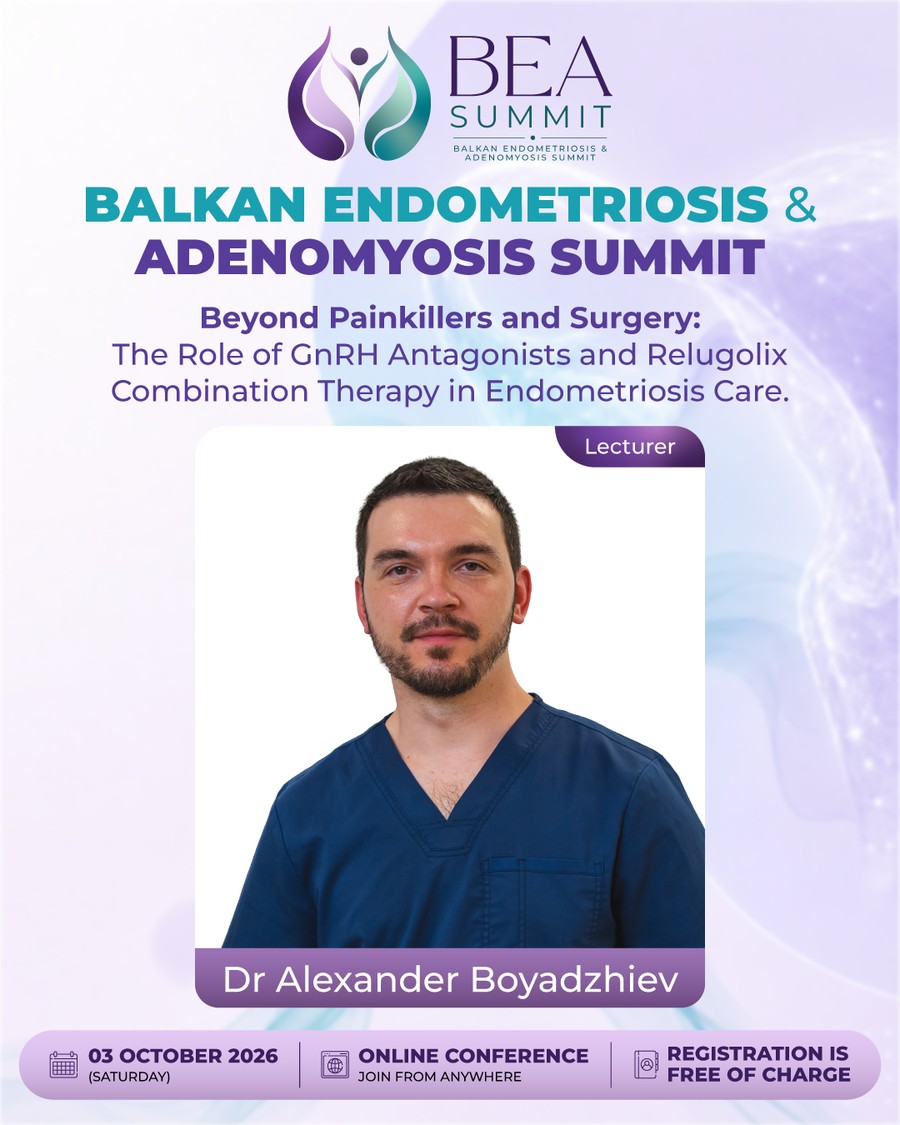
Dr. Alexander Boyadzhiev is a Bulgarian obstetrician-gynecologist and minimally invasive surgeon specialising in endometriosis, operative gynecology, and fertility-preserving approaches. He is part of the team at the Dr. Shterev Medical Complex and its Endometriosis Center, where he focuses on the diagnosis and surgical treatment of complex cases. He graduated from medical school in Varna, completed his residency in obstetrics and gynecology in Sofia, and underwent advanced training in endoscopic and 3D laparoscopic surgery in Italy, Belgium, and Germany, certified by ESGE/GESEA. In addition to his surgical practice, he has long been interested in the medical treatment of endometriosis, including comparative studies on GnRH agonists and antagonists, which are now a key part of modern therapy.
On 3 October 2026, Dr Boyadzhiev will join the Balkan Endometriosis & Adenomyosis Summit 2026 - a free, online conference in English bringing together leading specialists and patient organisations from across the region.
The conversation with Dr. Alexander Boyadzhiev traces how minimally invasive surgery became his professional focus thanks to his early training at leading endoscopic centers and his subsequent specialization in Italy, Belgium, and Germany. He explains how a multidisciplinary approach is key to managing complex endometriosis and why treatment must be individualized, striking a balance between medication, surgery, and fertility goals. The interview also highlights the role of modern GnRH antagonists and combination therapy as an important step toward safer and more effective long-term management of the disease.
I graduated from the Medical University of Varna and then moved to Sofia to specialize in Obstetrics and Gynaecology at a hospital with an exceptionally strong focus on minimally invasive gynaecologic surgery. It was a very conscious choice, because I already knew the high standard of care and the level of expertise in that institution.
What attracted me to minimally invasive surgery is that it brings together many of the things I believe should define modern medical care. It is highly precise and technically demanding, but at the same time, it is very much patient-centred. When we can achieve the same, or better, surgical outcome with less trauma, less pain, a faster recovery and an earlier return to normal life, I believe that is a very important part of what we should strive for as physicians.
As I developed in this field, I also realized how important it is to learn from experienced surgeons beyond my own environment. That is why I pursued additional training in advanced endoscopy and 3D laparoscopy at established gynaecological centres across Europe. Seeing different approaches and learning from different experts has helped me continuously broaden my skills and shape the kind of surgeon I am.
For us, specialised care starts with the understanding that endometriosis is a whole-body disease, and that shapes the way we approach each patient.
Our goal is not simply to suppress symptoms temporarily, but to look deeper and address the disease as comprehensively as possible, while also considering the patient’s individual goals and quality of life.
Because complex endometriosis can affect different organs and different aspects of a woman’s life, no single specialist can provide the complete picture. That is why we work as a multidisciplinary team, bringing together reproductive medicine specialists, pain-management specialist, urologists, colorectal and abdominal surgeon, radiologist, physiotherapists, psychologist and nutritionist.
We combine their expertise to create an individualised plan for each patient — whether the priority is pain control, fertility, surgery, organ preservation, rehabilitation, or improving quality of life.
For me, that is what specialised multidisciplinary care really means: treating the patient, not just treating the lesions.
What influenced me most during my work abroad was actually the level of expertise I saw around me. Of course, advanced technology, excellent equipment and good working conditions are important, but I came to appreciate that the most valuable resource in any medical institution is its people.
I was particularly impressed by specialists who had invested so much in their own development that they were able to provide the highest level of care to their patients, while also being willing to share their knowledge and experience with other colleagues.
That has had a strong influence on my own approach to surgery. It reminded me that becoming a good surgeon is a continuous process and the biggest lesson was not a particular instrument or technique, but the importance of expertise, continuous learning, and the people behind the technology.
I think treatment planning in endometriosis is science with a pinch of art. We have guidelines and scientific evidence to guide us, but there is no single treatment that is right for every patient.
When deciding between medical therapy, surgery, or a combination of both, we look at the whole picture: the patient’s symptoms, the extent and location of the endometriosis, whether other organs are involved, her fertility plans, and, very importantly, her personal goals and expectations.
It is a shared decision between the patient and the medical team. We need to explain the available options, their potential benefits and risks, and understand what matters most to that particular patient.
This shows that my interest in endometriosis goes back much earlier than my active clinical practice. My early academic work gave me an opportunity to explore the disease and its medical treatment at an early stage in my career.
Over the past decade, our understanding of endometriosis has evolved considerably, and so have the recommendations for its treatment. A major reason for this is the growing body of scientific evidence. As clinicians, I think we have to be prepared to evolve with that evidence and continuously reassess how we approach our patients.
This has also been a very personal process for me since I had the opportunity to participate in a clinical study of a treatment combining a GnRH antagonist with add-back therapy. It was particularly rewarding to see the treatment that I had encountered in the research setting later become an established and widely used option in the management of endometriosis.
Today, I see modern antagonist-based treatments as having an important and well-established place in medical therapy for endometriosis.
GnRH agonists and GnRH antagonists are second-line medical therapies for endometriosis, and we know that they can be highly effective in controlling the disease and its symptoms. However, their effectiveness has to be balanced against the significant long-term side effects associated with profound oestrogen suppression.
This is where the development of GnRH antagonist combination therapy represents an important step forward. By adding estrogen and progestogen — the so-called add-back therapy — we can maintain the therapeutic benefits of the GnRH antagonist while reducing the unwanted effects associated with long-term hypoestrogenism.
In this way, the treatment approach has evolved. Instead of simply accepting the adverse effects as the price of effective treatment, we are able to find a better balance between efficacy and safety, making this approach relevant for a much broader group of patients who need long-term medical management.
I think Bulgarian medicine is already positioning itself well on the international stage, and I say that with full awareness that we still have a lot of work to do when it comes to endometriosis care. But I think that is true almost everywhere in the world — endometriosis remains a challenging disease to diagnose and manage.
Of course, there are countries and specialised centres from which we can learn, whether in terms of know-how, healthcare policies or clinical experience. But I believe we have the capacity to develop our own system through constant and gradual improvement.
Over the next decade, I hope to see more specialised endometriosis centres developing across Bulgaria, ideally in every major city, where specialists with a particular interest and expertise in endometriosis can work together. I believe this would help ensure that more patients with suspected endometriosis are recognised earlier and referred appropriately, leading to more timely and accurate diagnosis.
When it comes to treatment, I think the priority is to improve awareness of the principles of endometriosis management across all aspects of the disease. Where appropriate, patients should have access to medical treatment, and when surgery is necessary, it should ideally be performed in specialised centres by teams with the appropriate expertise.
Register free to attend Dr Alexander Boyadzhiev’s session and the full BEA Summit 2026 programme.
Register Now