 BEA Summit is Live
BEA Summit is Live
BEA Summit is Live
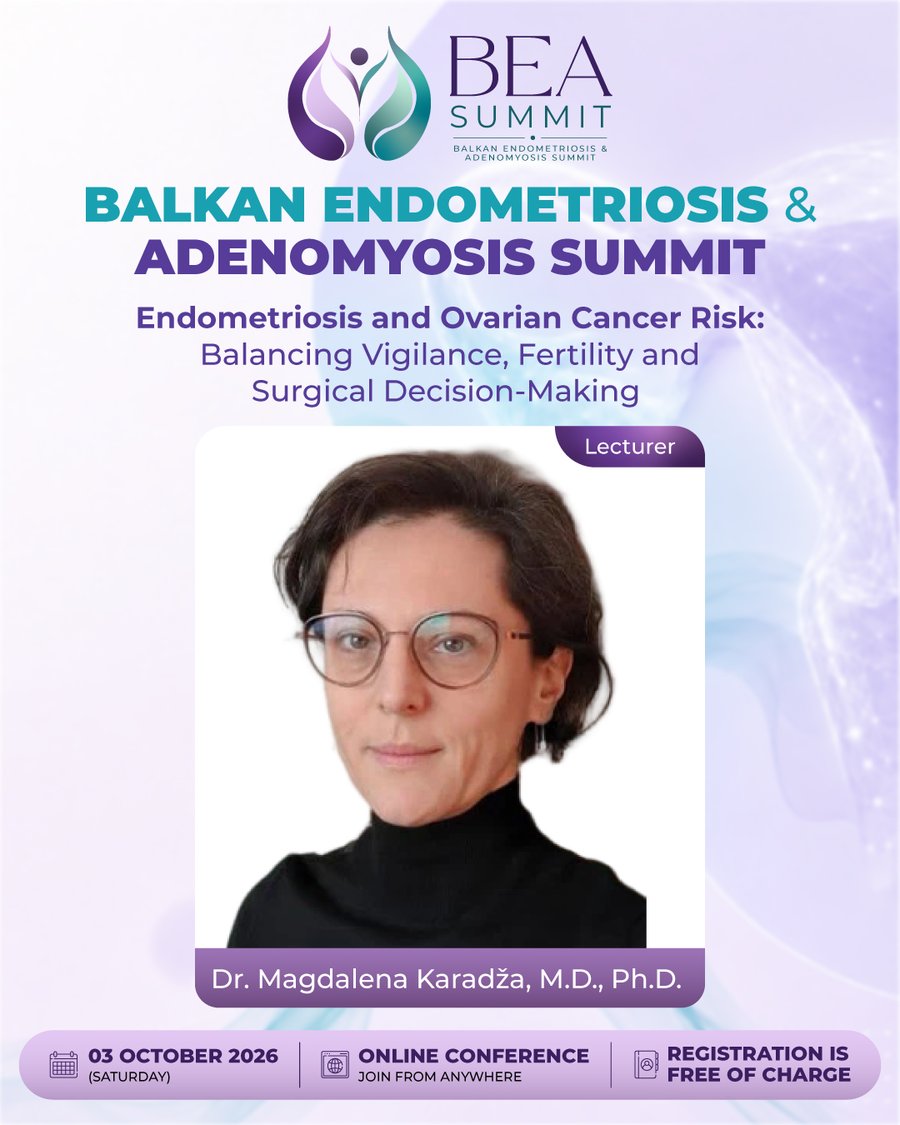
Dr Magdalena Karadža is a gynaecologist and reproductive surgeon at KBC Zagreb, with a strong dual specialisation in gynaecological oncology and reproductive medicine. She specialises in minimally invasive surgery for endometriosis and places particular emphasis on preserving fertility during surgical treatment. Her international experience and involvement in the EUmetriosis consortium shape her approach to personalised care and her in-depth understanding of the condition. Her research and teaching reflect the same focus on the link between surgery, anatomical precision and long-term reproductive health.
On 3 October 2026, Dr Karadža will join the Balkan Endometriosis & Adenomyosis Summit 2026 - a free, online conference in English bringing together leading specialists and patient organisations from across the region.
The conversation with Dr Karadža explores how her unique combination of oncology and reproductive surgery shapes her approach to complex pelvic surgery, where precision must go hand in hand with preserving function. She discusses the greatest challenges in minimally invasive endometriosis surgery, the role of multidisciplinary teams and the need for careful assessment of when surgery truly benefits fertility. The interview also outlines the future of endometriosis care in Europe — better diagnosis, personalised solutions, scientific consortia such as EUmetriosis, and the training of a new generation of surgeons who prioritise patients’ long-term reproductive health.
My oncological background allows me to approach complex pelvic surgery with the principles of radical surgery, with a strong understanding of anatomy and surgical planes. This can sometimes conflict with the fundamental goal of reproductive surgery, which is preservation. Having both perspectives means constantly balancing oncological safety with preservation, particularly in endometriosis surgery. This dual training helps me make the best surgical decision for each patient when preservation is possible, but radicality is necessary.
The most challenging decision is often not how to operate, but when to operate. Surgery, particularly ovarian surgery, can negatively affect ovarian reserve and reproductive outcomes. Therefore, it is necessary to carefully consider whether surgery will truly benefit the patient. Sometimes the difficult decision is choosing between surgery and ART, and there is no one-size-fits-all answer. The key is to individualize the approach, balancing symptom control and surgical indications with the patient’s ovarian reserve, fertility plans, and reproductive goals.
The most challenging patients for all are those with deep infiltrating endometriosis (DIE). Surgery for DIE is highly complex and carries significant risks and potential complications, so it requires careful patient selection and, very often, a multidisciplinary approach. We constantly have to weigh the potential benefits of surgery against its risks. I believe this is a challenge shared by all centres dealing with advanced endometriosis. Another important issue is the lack of adequately trained gynaecologists—not only in performing complex endometriosis surgery, but also in recognising and diagnosing the disease early enough. Timely diagnosis and appropriate referral are essential if we want to improve outcomes for these patients.
Oncology background certainly influences the way I approach complex endometriosis surgery, but perhaps not in the most obvious way. When operating on ovarian endometriosis, oncologic radicality has to be deliberately set aside. An endometrioma is a benign condition, affecting young women in whom preservation of ovarian function and fertility is extremely important. Therefore, the surgical objective should not be maximal excision at any cost, but rather maximal disease clearance with maximal preservation of healthy ovarian tissue.
At the same time, oncological training and philosophy are extremely valuable in making sharp surgical decisions. It also teaches you to remain alert to unexpected findings. In ovarian endometriosis, particularly when the morphology is atypical, oncologic thinking means recognizing when a lesion does not behave or look like a typical endometrioma and adapting the surgical strategy accordingly.
So, for me, the value of an oncologic background in endometriosis surgery is not in bringing oncologic radicality into benign surgery, but in bringing oncologic precision, anatomical discipline, anticipation, and decisiveness—while keeping tissue preservation at the centre of the procedure.
Being part of the EUmetriosis consortium is a very exciting opportunity because it brings together expertise from different disciplines and centres across Europe to address endometriosis from a much broader perspective.
We have great expectations from the project, and meaningful changes in clinical practice must be driven by robust scientific evidence. Our hope is that the results of EUmetriosis will help us better understand the biology and heterogeneity of endometriosis.
One of the major strengths of such a large European collaborative project is the ability to integrate clinical information with molecular, biological and other research data across different patient populations. Ultimately, we hope that this knowledge will translate into better diagnostic approaches, improved patient stratification and, eventually, more individualized treatment strategies. For clinicians, that is particularly important because we still have many unanswered questions when deciding which treatment is best for an individual patient. We are very much looking forward to the results, with the hope that they will give us new tools to understand the disease better and, most importantly, improve the care we can offer to women with endometriosis.
Тhe collaborations have reinforced the importance of a highly individualized approach to fertility preservation. There is no single strategy that is appropriate for every patient. Fertility preservation begins with thoughtful clinical decision-making and careful, tissue-sparing surgery, particularly in women with endometriosis.
The decision to operate on an ovarian endometrioma should never be taken lightly. While surgery may be necessary and beneficial in selected patients, it can also have an important reproductive cost. Endometrioma surgery may lead to a decline in AMH and a reduction in the ovarian follicular pool, particularly after bilateral or repeated procedures. We also need to remember that surgery is not a definitive treatment for endometriosis. The disease can recur, and some women undergo multiple ovarian surgeries over their reproductive lifetime. The cumulative loss of healthy ovarian tissue can have profound—and in some cases devastating—consequences for future fertility. For this reason, every indication for surgery should be carefully considered, balancing the expected clinical benefit against the potential impact on ovarian reserve.
The first, essential step is to increase awareness of endometriosis among all gynecologists, particularly because diagnostic delay remains a major problem. Young doctors need to recognize the symptoms and understand the disease early in their training.
Regarding surgery, training should go beyond mastering surgical techniques. Future surgeons must also learn when to operate—and equally importantly, when not to operate. Choosing the appropriate timing and indication for surgery is crucial, especially in young women, where every intervention should balance effective treatment with preservation of ovarian function and future fertility.
Ultimately, we need to train surgeons not only to perform technically excellent surgery, but also to make thoughtful, individualized decisions with the patient’s long-term reproductive health in mind.
Register free to attend Dr. Magdalena Karadža, M.D., Ph.D.’s session and the full BEA Summit 2026 programme.
Register Now